Making collaboration visible
Collaboration is just the first human skill we’re learning to make visible; dispositions, well-being and psychological safety ride the same listening infrastructure. MagpieMatrix is a research prototype that surfaces those skills from a classroom’s team talk — live, during the lesson, not weeks later. We’re building it with the teachers who trial it.
Adelaide University · CSIRO On Prime · Microsoft AFMR · In SA classroom pilots
↓
The most valued skills nobody can see
In an AI-shaped world, the most valuable skills are the most human ones — and the Australian Curriculum now mandates them. Schools must grow and assess collaboration, learning dispositions, well-being and psychological safety. Yet there’s no practical way to see any of it as it happens, so it goes ungraded, unimproved, and unfairly judged.
One teacher, six conversations
Collaboration happens at every table at once. Nobody can hear it all.
Opinions, weeks late
Surveys collect polite recollections long after the moment has passed.
No standard to stand on
No reliable data, no validation, no way to moderate one teacher’s judgement against another’s.
So the most human skills get opinion-based grades: observation stacked onto a 50-hour median week (AITSL 2025), with zero auditable evidence. The signal was always there, in what students say to each other. (And the world is betting big on the gap: education spend heads past US$10T by 2030, in a A$4B+ EdTech sector that still can’t see these skills live.)
We interviewed 42 stakeholders: teachers, parents, regulators, policymakers. Every single one pointed to the same thing: the burden on teachers.
CSIRO On Prime · 2025 · read about MagpieMatrix on CSIRO ↗
How the magpies work
No laptops, no screens for students. A passive listener sits with each team. Here’s what that does, in two moves: first what changes in the room, then how the talk becomes evidence a teacher can act on.
Data minimisation Australian Privacy Principles
School-segmented cloud In-region storage · APPs & EU GDPR
Human oversight, always AU Framework for Generative AI in Schools
Consent & ethics first University HREC-approved research
A use case: Inside Jigsaw
The mechanism works anywhere. Here’s why you’d reach for it. Jigsaw is a structure you might already run: students split a problem, become experts, then teach each other. You only ever see the finished product. The magpies show you the exchange in between: who explained, who built on whom, where understanding actually landed.
Why trial this?
You’re already expected to grow and assess these skills. MagpieMatrix is an early research prototype working to surface them from real dialogue — and the teachers who trial it help shape what it becomes.
Aligned to your curriculum
Maps to ACARA general capabilities, SACE and learning dispositions: the skills you’re already required to assess, working toward evidence you can stand behind.
A brand-new lens
See what was invisible: well-being, psychological safety, leadership, cohesion and problem-solving, surfaced live from real dialogue.
Shape what gets built
You’re not buying a finished tool, you’re helping build one. Your lessons and feedback steer the research, and your students benefit along the way.
Backed & validated by
Microsoft AFMRA$24,000 · LLM development
ECR Seed GrantA$5,000 · platform + LLM-CPS publication
CSIRO On PrimeMarket validation · 42 interviews
CRUXESCustomer discovery program
The science behind it
Several years of peer-reviewed work on making collaboration observable (as first author and co-author alongside wonderful colleagues), including one of the first LLM-validation studies of collaborative problem-solving assessment from real classroom dialogue.
In preparation
01 / 10
In preparation · preprint coming
Context-aware agents for surfacing problem-solving skills over time
The next step: agents that follow a team across a task and read how their problem-solving unfolds, moving from measuring skills to evaluating the AI agents that assess them.
In preparation
02 / 10
In preparation · preprint coming
Surfacing student well-being through collaborative learning dialogue
Can how a team talks tell you how its students are doing? Early work on hearing well-being in ordinary classroom dialogue.
 03 / 10
Under review: IJAIED (Q1) · preprint on EdArxiv
Puts large language models up against trained human coders on real classroom talk, and asks how far they can be trusted to assess collaboration.
 04 / 10
Artificial Intelligence Review · 2026
How an AI teammate is built shapes whether the people working with it end up trusting it. A review of 34 studies connecting the two.
 05 / 10
Learning and Instruction · 2026
Reads how tightly a team is pulling together from the traces of an ordinary lesson: no surveys, no interruption.
 06 / 10
Int. J. of Computer-Supported Collaborative Learning · 2024
What students say about pulling together on a task, set against what their team actually did.
 07 / 10
Technology, Knowledge and Learning · 2024
When the AI stops being a tool and joins the group: what students expect of it, and where their trust runs out.
 08 / 10
Journal of Computer Assisted Learning · 2023
Cohesion recovered from the digital footprints teams leave behind them in an online learning platform.
 09 / 10
Computers & Education · 2022
What teams actually do once you hand them a dashboard about themselves, and what makes them act on it.
 10 / 10
Educational Research Review · 2022
Two decades of research on what holds a small group together when the learning runs through technology.
Where the work reaches
Red marks where the magpies are on the ground: Adelaide, Wollongong, the Netherlands. White traces the research reach: talks and workshops from Kyoto to Dublin, and co-authors from Valladolid to Medellín. Drag the globe; tap a marker.
The road ahead: a validity chain
We don’t assume collaborative-learning evidence naturally becomes useful in practice. The research forges a staged evidence chain: measurement, interpretation, instruction, durable learning. The first link is forged; the magpies make the next three possible.
Measurement validity
Assessment-of-learning science
Are the measures valid, generalisable and equitable?
Delivered: LLM-measured CPS from real classroom dialogue, under review (Q1).
Know more
- Measurement invariance across subject domains, year levels and school contexts
- Equity across learner subgroups: differential item functioning and bias analyses
- Scaling to system-level deployment without losing construct validity
Interpretive validity
Assessment-for-learning science
How do teachers read the evidence, and what do they do with it?
Observable: what teachers read, ask and decide when the evidence arrives.
Know more
- What pedagogical decisions follow from AI-mediated representations of CPS evidence
- How summaries, visualisations and exemplars shape the questions teachers ask
- Whether evidence strengthens formative capacity and agency while cutting workload
- Best-practice visualisation, co-designed with schools, educators and students, so teachers get the most value from the insights
Instructional validity
Assessment-as-learning science
Do teacher-mediated interventions change collaboration?
Teachable: does CPS-informed teaching move groups measurably?
Know more
- More balanced cognitive and social participation: elaboration, turn-taking, conflict resolution
- Feedback loops that prevent collaborative breakdowns and sustain engagement
- In-action interventions vs retrospective feedback vs standard practice
Consequential validity
Learning-outcome science: beyond assessment
Does it stick, and transfer?
Durable: what remains when the scaffolds come away.
Know more
- Persistence of CPS gains once AI and teacher prompts are removed
- Transfer across subject domains, task types and group configurations
- Attribution: teacher action vs AI mediation vs student internalisation
- Unintended consequences: over-reliance, reduced autonomy, compliance over collaboration
The man behind the magpie
MagpieMatrix wasn’t born yesterday
Built by one pair of hands, inside the centre that made it possible: C3L, Adelaide University.
Dr Andrew Zamecnik, Early Career Researcher, C3L, School of Education, Adelaide University
I build tools that give teachers their time back. MagpieMatrix is built from the ground up, by hand (devices, cloud, analytics, AI agents), and it’s in classrooms across South Australia and the Netherlands right now. Named for the garden magpies that inspired it: clever, social, looking after each other.
16+ peer-reviewed publications 364 citations h-index 8 3 papers in Scopus top 1% in education
News & upcoming: see it in person
Close to home, we’re in the booths at the state’s biggest gathering of public secondary school leaders.
6–7 August 2026 · Adelaide
SASPA Annual Conference
The South Australian Secondary Principals Association brings the state’s public secondary leaders together at Morphettville Event Centre, under the theme Equitable Excellence: Empowered by Collective Agency. We’ll be there with a booth, showcasing the magpies to the leaders of the schools they’re built for.
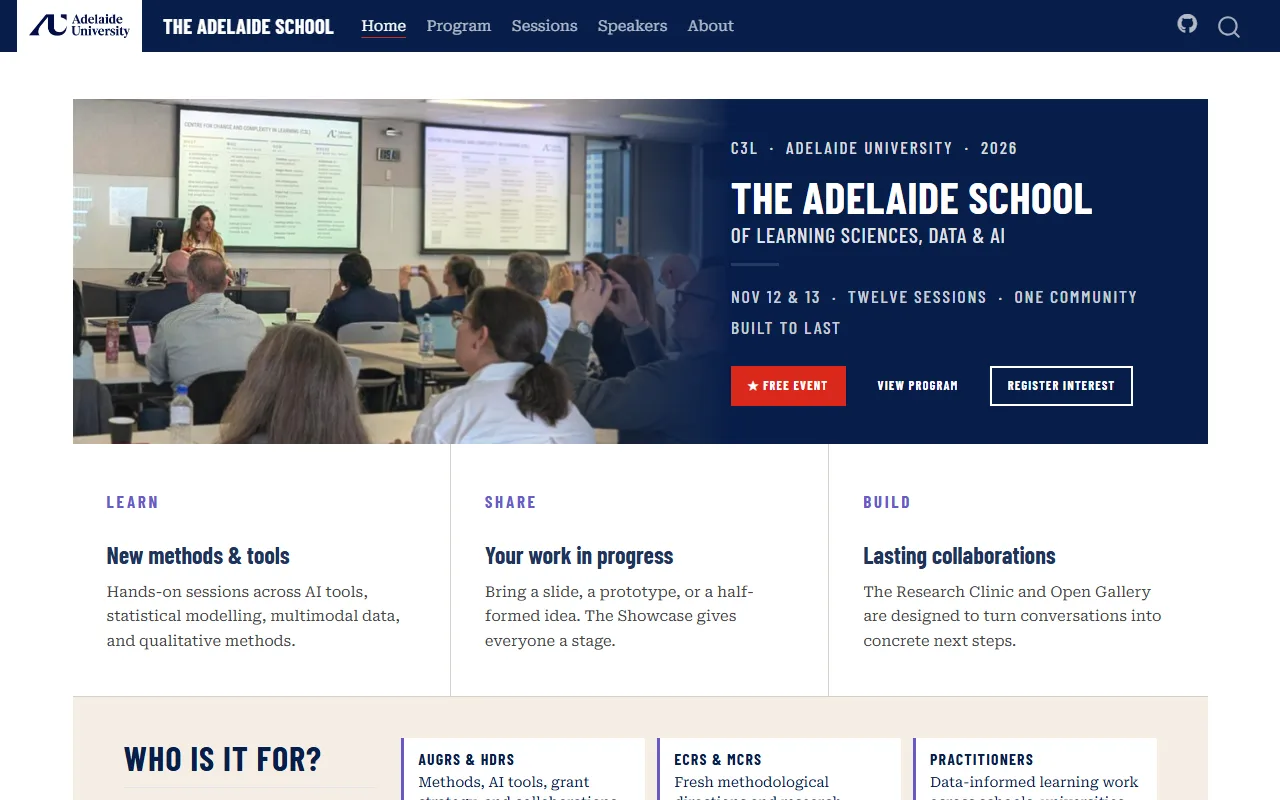
MagpieMatrix is on the program at The Adelaide School of Learning Sciences, Data & AI, a free, hands-on two-day school hosted by C3L at Adelaide University.
12–13 November 2026 · Adelaide
A working prototype for real-time surfacing of learning dispositions in K-12 collaborative learning
As part of the school, Andrew Zamecnik is leading a panel on learning dispositions and MagpieMatrix, joined by teacher Jarrod Johnson and other brilliant colleagues. See the device and the evidence up close, and ask the people who run it in a real classroom.
Further afield, work from MagpieMatrix will also be presented in North America.
14–18 April 2027 · Toronto
The magpies head to Toronto
MagpieMatrix research is making its way to the American Educational Research Association (AERA) Annual Meeting, one of the largest gatherings in education research. The 2027 theme: Transcending Borders and Boundaries in Education Research.